Saturday, November 15, 2008

Examples of Cultural Similarities between those in the Nile Valley and those in other areas of Africa

The goal here is to highlight cultural parallelism or similarities between Dynastic Egypt and elsewhere in Africa from various sources; mind you, not to argue for or against cultural diffusion between communities in the said regions. Let's start this compilation of cultural parallels between ancient Egypt and other parts of Africa with the "Rainmaker King", neatly described in the following 2004 piece by Simon Simonse, Kings and Gods as Ecological Agents: Reciprocity and Unilateralism in the Management of Natural Order; an interesting piece that goes over the impact of ecological situations on interaction within communities and visa versa, how that ties into Kingship and ritualization. It serves as an interesting demonstration on how the thin layer of the ruling elite sought to legitimize their authority by appealing to divine connection, as being agents divinely appointed to their role or place in society, which at times [like a double-edged sword], that is to say — in times of natural disasters and extraordinary hardship came back to bite them in the behind, when leaders failed to curb said hardship of the people...  

Kingship:

The Rainmaker concept  
Among the Lulubo and Lokoya, responsibility for the various aspects of the natural environment that can be critical for community survival is allocated to the different clans. In case of a crisis (drought, infertility) the clan associated with the problem, is the target of investigations. The main investigation strategy is to check, one by one, the quarrels members of that clan have been involved in. When such a conflict has been identified, a solution is suggested: by way of reconciliation or restitution. Of particular interest are provocations of the responsible clan official. If a settlement of the dispute fails to bring the required result, there will be more rounds of investigation. If no solution is found the official of the clan associated with the disorder will be suspected of deliberately sabotaging the community. Accusations and counter-accusations will be thrown back and forth. The clan-official stands face-to-face with the community. If the disaster subsides, and if he uses the expectations focused on him cleverly, he may come out as a more powerful and wealthier member of the community. If the disaster prolongs, and there are no other candidates left to be blamed, he must be killed. He ends up as the scapegoat of his community.  

This type of drama is most elaborate in the case of the Rainmaker. Of the various public concerns the weather has the greatest dramatic potential. Rains are capricious and localised. Rain falls over a period of 9 months. Its timeliness is a precondition for the two main harvests. The tension is particularly high in June when the first crop is about to be harvested and the annual period of hunger is peaking. The power of Rainmakers is built on this suspense. If they manage the rains well they gain in prestige. If the rains fail the community turns against its Rainmaker blaming him or her of drought. For as long as the drought persists, the confrontation between the king and his community will escalate. The process follows the steps listed in the attached table. It may ultimately lead to the Rainmaker being killed. In the area I studied I identified 26 cases of accomplished killings of kings within living memory. As the crisis deepens and the need for a solution rises all members of the community, including women and children, are gradually drawn into the process. It is the most dramatic manifestation of the community acting as a unified entity…

The clan-leaders, Rainmakers, the Master of the Bush, Master of the Soil, the Master of Birds etc. are given recognition by being given designated parts of game after a hunt, the first catch of white ants, etc. They may be reminded of their responsibility by an annual sacrifice at the beginning of the season. Clan- officials are also called on on a private basis: to bless a newly cleared field, heal barrenness, to protect against pests…  

Between the different ecological responsibilities, rain is the most important. The importance not only depends on its practical importance for agriculture but also on its potential for generating social consensus during a period of crisis. While the Rainmaker usually shares the title of ‘King’ (Lulubo ‘osi’, Lokoya, ‘ohobu’ Lotuho ‘hobu’) with two or three other officials (usually fertility and soil) their cosmological position as ‘kings of heaven’ is matched by the highest social status.

Reciprocity in the management of natural order may be negative as well as positive. If the members of the community provoke the clan official, disorder will follow: leopards may turn up at unusual places, the soil will turn infertile, and women have miscarriages. Initial solutions for addressing such disorder are through mechanisms of exchange, by way of restitution and restoration. However the reciprocity is not between the community and the environment but between different clans using their ecological powers to blackmail others and create dependency…  

In few ethnographic areas is the continuity between kingship and divinity, captured in Rene Girard’s famous phrase that “gods are dead kings as much as sacred kings are gods who have not yet died”, so easily visible as in the Nilotic world. The death of the Eastern Nilotic Rainmaker/King plays a key role. If he dies as a victim of the crowd, his death is expected to release the rain and to re-activate ecological normality. If the King dies a non-violent death his powers will remain active for at least one complete season. For that period the tomb will be the object of ritual attention. For about one year after his death the King will not be succeeded. The dead King reigns. Before the new rainy season, after the tomb has been flattened, a new person will take over. We could say that these kings enjoy a short-lived divinity. The power of the king and that of divinity are continuous. The same terms are used for both. To say that a certain rainmaker’s powers are effective the Lulubo will say: the man is really ‘ juok’ . “Juok’ is the word used for God. 

Source: Kings and Gods as Ecological Agents: Reciprocity and Unilateralism in the Management of Natural Order

More on the Rainmaker King, we have the following excerpt taken from Stuart Piggott's work on the "The Dawn of Civilization", with references to Cyril Aldred's "Egypt to the End of the Old Kingdom",...

"But although the purely archaeological evidence might appear to demonstrate a parallel development in the two areas, we know that in fact this, though superficially existing in material culture, was not the product of identical societies, nor was it leading to such state of affairs. In Mesopotamia the beginnings of little independent city-states under tutelary gods, rulers, councils and assemblies are perceptible, though later to be submerged in a familiar pattern of oriental despotism, but in Egypt from the beginning we are able to glimpse that essentially African figure, the omnipotent, rainmaking, god-king. The prehistoric cheiftain, a rainmaker and medicine-man, with magic power over the weather and therefore able to keep his people in health and prosperity becomes with the founding of the first, the Pharoah, a divine king being in command over the Nile and able to sustain and protect the nation."

One sees elements of this divine kinship and its ability to manipulate natural climatic-geological matters in predynastic concepts of the "god in the city", as put forth by Budge; if one thinks about it, pre-dynastic Egypt was made up of Lower and Upper Egyptian kingdoms, which means each had their own local gods and beliefs...

In prehistoric times every little village or town, every district and province, and every great city, had its own particular god...  

The god of the village, although he was a more important being, might be led into captivity along with people of the village, but the victory of his followers in a raid or fight caused the honours paid to him be magnified and enhanced his renown. [kind of like what we see in the Rainmaker King concept]  

The gods of provinces or of great cities were, of course, greater than those of villages and private farmilies, and in the large houses dedicated to them, i.e., temples, a considerable number of them, represented by statues, would be found...  

whenever and wherever the Egyptian attempted to set up a system of gods they always found that the old local gods had to be taken into consideration, and a place had to be found fo them in the system. This might be done by making them members of triads, or of groups of nine gods, now commonly called "enneads"; but in one form or other they had to appear. The researches made during the last few years have shown that there must have been several large schools of theological thought in Egypt, and each of these the priests did their utmost to proclaim the superiority of their gods... 

we see that the great god of Heliopolis was Temu or Atum, the setting sun, and to him the priests of that place ascribed the attributes which rightly belong to Ra, the Sun-god of the day-time. For some reason or other, they formulated the idea of a company of gods, nine in number, which was called the "great company (paut) of gods", and at the head of this company they placed the god Temu...

The priests of Heliopolis in setting Temu at the head of their company of the gods thus gave Ra, and Nu also, a place of high honour; they cleverly succeeded in making their own local god chief of the company, but at the same time they provided the older gods with positions of importance. In this way worshippers of Ra, who had regarded their god as the oldest of the gods, would have little cause to complain of the introduction of Temu into the company of the gods, and the local vanity of Heliopolis would be gratified. - E. A. Wallis Budge, Egyptian Religion.

Another ritual attached to kingship, is brought to attention by Marie Ange, in the following extract:

BONHÊME, Marie-Ange, Appétit de roi, in: Hommages Leclant 2, 45-53. Discussion of the theme "eating the kingship," a practice attested in Papyrus Brooklyn (47.218.50, col. XVI, 6-7) describing the rites of the "confirmation of the royal power in the New Year." In these rites the king is eating the jAw.t/jA.t symbol in bread. There seem to be some similarities between the described Egyptian rites and the conception and practice of "eating the kingship" in certain African kingdoms.

Courtesy of some poster going by the moniker of "Pax Dahomensis" on a discussion forum, the following was brought to attention:

There are several sources dealing with cultural comparative studies between Kmt and traditional other African cultures. Unfortunately I only have a few of them at home so the following information will be largely incomplete. Most of the following information is taken from Egyptologists Aboubacry Moussa Lam, Oum Ndigi and Jean Charles Coovi Gomez' francophone works. I have found myself a lot of other similarities but as I plan to publish them in the future, I don't want to post them on here for now.  

I) Pantheon and Mythology: Many Kemetic deities are still worshipped in modern Africa.Here are a few. Oum Ndigi demonstrated by showing ten homophones of Geb's names identical to their counterparts in Basaa which are also homophones of a Basaa deity called Koba, that Geb and Koba are the very same deity. He also pointed out some mythological parallelisms such as the identification of Geb and Koba to the Time, to a goose sitting on the Primordial egg, to the fifth of the Primordial ancestors, etc...  

Aboubacry Moussa Lam pointed out some striking resemblances between Dogon and Kemetic mythologies. Like in Kmt, the Dogon creation began with primordial waters (called Nommo in the Dogon language ,a word related to the kmtic Nwmw which would most logically be the actual translitteration of one of the mdw ntr usually translitterated by Egyptologists as "Nwnw"(Nun)), which are "populated" in both areas by reptile-like creatures. From these waters came out eight creatures that came to life as couples: they are thus an ogdoad but become an ennead along with the creator god just like in Kmt. The supreme God of Dogon people is called Amma, a name related to 'Imn (Amun) according to Théophile Obenga and both Gods do use their penises and speech to create. Like Amun who was invoked by Pharaohs to make the level of water rise, Amma is a water god. Still according to French Africanist Marcel Griaule, Amma is a ram wearing a calabash between his horns representing the sun.We all know that Amun was often depicted as a Ram wearing but he actually wasn't before the New Kingdom:he was only a provincial unsolarized deity and wasn't assimilated to the ram back then. It would thus mean that contacts between the two populations occurred after the NK.Pic of Amen-Ra at Abu Simbel:


Recently, Théophile Obenga said that the name of the supreme God of Dagari people of Burkina Faso was Myin and that this name was related to 'Imn.Interestingly enough, Myin is also considered to be the sun to Dagari people. Perhaps some meticulous comparative researchs about Myin and Amun could lead to the same conclusion as the relationship between Amun & Amma.  

II) Conception of death Kemetians had a conception of death quite similar to that of modern Africans. According to this page:

Because Re was Atum as well as Amun, people saw him as simply another form of the Creator god. Because he traveled each day through the heavens, he was also the god of time. The “birth” and “death” of the sun each day helped the Egyptians to understand time, life, death, and resurrection. The sun gave the Egyptians confidence that life never ended, and that death was merely another form of life. The Kushites shared the same beliefs.  

About the BaKongo people of Central Africa, this page says:

Life in that sense is a cyclical and repetitive movement between the two worlds mentioned above, resembling the path of the sun. At the rising and setting of the sun then, the living and the dead exchange day and night. In Kongo belief, man's life does not end, it constitutes a cycle, and death is merely a transition in the process of change. Following that belief, a man's soul does not dwell in the grave after his death but leaves it to become a ghost (n'kuyu) in the land of the dead, which is called ku mpemba a fula.  

Akh:  

This was the form in which the blessed dead lived on in the hereafter. It was also the result of the union between the Ba and the Ka. An Akh was believed to live on unharmed for eternity, they were sometimes referred to as 'The Shining Ones'.  

French Africanist Louis Vincent Thomas reported a fon chant describing death(ku) as an illumination after which life would no more lived be into darkness.

According to Egyptian beliefs, the soul of the dead accompanied the sun on its eternal journey in the Upper Waters (the heavens) around the world. A boat or at least a model of a boat was therefore included in every tomb.  

Beninese anthropologist B.Adoukonou reported that the dead had to travel with a boat to the world of the deads. Many people of modern day Africa do use the same term as the Md Ntr "akh" meaning "to become a spirit",e.g. ku le-ku. Of this word are also derived terms meaning "ghost" in these languages e.g. kutito(fon-gbe),okue(mbochi) just like akhu(ghost) derives from akh in the Mdw Ntr.  

When French missionaries discovered the term "okue", they systematically and erroneously translated it by "devil". Interestingly in Coptic, akhu also means "devil "although we know that they were definitely considered as such during pharaonic Times. Perhaps the Christians who evangelized both Kemetians and Mbochi people had the same reaction vis à vis of the same concept.  

A representation of an animated Djed Pillar:


A Kutito/Egungun ceremony in Porto Novo,Benin: 


In Togo,Benin and Nigeria, the Kutito(among Gbe speaking people) and Egungun (among Yoruba speaking people) are masked dancing ancestors returning to earth to help and punish living people. Jean Charles Coovi Gomez pointed out that this ceremony was exactly the same as what we know of Kemetic "raising the Djed Pillar Ceremony".  

Egungun ,the Yoruba name of the ceremony means "bone, skeleton". In Kmt, the Djed pillar was considered as the backbone of the neter Ausar. There is ample evidence for mummification in traditional Africa. Félix Dubois reported it among Songhoi people, M.Delafosse among Baule(Akan) people of Ivory Coast, A.M.L Desplagnes among the Dogon and Mossi, J.C.C.Gomez among the Yoruba.  

Mummy of the Obi Ijeh of Idumuoghu,Ibusa, Nigeria From Oscar Pfouma "Histoire culturelle de l'Afrique Noire": 


The Dogon sign "gono" or "gonono", written at the end of the Sigi Time (sixty years) and identical to the Egyptian "ânkh" represents God after he created the world. Ancient Egyptians also celebrated, each sixty years, a ceremony called "hn" representing the renewing of the world. The osirian rite Sâh and the Dogon Sigi are isomorphic. The relationship between AE and modern Black Africa is irrefutable.  

Dogon gonono:"a 60 years time"  
Egypt hnn:"a 60 years time"(Budge)  
Dogon Sigi  
Egypt sâh
Dogon Naporo=Osiris  
Egypt Npr=Osiris(E.Naville)

The Egyptian word for deity but also pharaoh, Ntr is also found in modern BA languages as thus:  

Coptic:Noyte, Nute  
Gurma:Unteru(god)  
Gurmantche:"Untenu"(god)  
Fulani:"Ntori"(god)  
Masai:"Naiteru"(god)  
Kwasio:"Nture"(sacred)  
Mombutu:"Nôro"(god)  

BA and AE religious customs are exactly the same;Hermopolitan cosmogony is found among Northern Cameroon populations.According to M.Maubert "Coutumes du Gurma":

"it is impossible (...) even for a layman, to not mention (...) AE, more precisely Hermopolis in Middle Egypt, whose specialists tell us that its cosmogony was about some elements (...)very similar to those we had the surprise to found among Fali people.A primordial egg or "Mother Egg". Two waters existing before everything, (...) "Waters containing waiting germs of creation (...) the only trait common to all the AE cosmogonies (...)" Existence of two lands and four rivers. The intervention of an ogdoad, whose members ,the organizers of the world who worked to built the more or less complete state of the world we know today (...) were originally one and same divinity but represented four entities and finally four couples (...), each couple representing the male and female aspect of one of the other entities (...) The classical iconography shows this eight characters as strange anthropomorphic creatures (...) frog-headed men, snake-headed women in Egypt and are described as crawling beasts living in muddy waters in Cameroon. Even the black ape, mentioned by Lebeuf reminds us of Thot, the baboon-headed god of Hermopolis."  

The name of Thot(Greek name for Djehuti) is still found in Modern BA:Zukta, Zigta,(Muhuleh), Jukta(Jukun).

Speaking of mummy traditions, indeed one can argue that it likely had its origins amongst certain communities in pre-historic Sahara, as the so-called Uan/"Black Mummy" found in the Libyan desert exemplifies.

Parallels in posturing...


Top image shows the Fon art on the left hand side, which is reminiscent in its theme, of the ancient Egyptian wall relief of Rameses smiting an enemy on the right hand side. Bottom image shows another example of parallels between west Sahelian/Sub-Saharan art [likely Benin carving] — sporting the head of some carnivorous creature [likely a feline of some sort] on the left hand side, and two ancient Egyptian figurines — one sporting a falcon head, and the other, a feline; what stands out here, is the remarkably similar standing postures, particularly what they are doing with their arms and hands.  

Parallels in color conventions
The ancient Egyptians were not the only ones to depict their fellow dark skin African neighbours in dual contrasting tones; the following image shows a conflict between the Fon warriors and their Yoruba counterparts. Both of these groups would generally be seen as dark skin peoples, but from the image below, this might not be immediately apparent to anyone unfamiliar with these peoples...


Parallel themes in art centered females

Nursing
Kemetian art, like any other, speaks for itself. For instance, Kemetian art had certain features that were similar to that of other ancient African culture. You'll see what I mean...

Nursing Woman. From Giza: 5th Dynasty (ca. 2420-2389 B.C.E). Limestone with remains of paint. (courtesy of metmuseum)

Akan [Ghana] wood carving of a female breast-feeding a young one; not unlike the theme being communicated in the ancient Egyptian rendition above.  

Fertility Dolls


On the far left, is an ancient Egyptian "paddle" doll, courtesy of the British Museum; in the middle, we have Ashanti examples of the fertility doll, and third image is yet another example of fertility dolls common amongst the Akan.

Fertility dolls are a fairly common theme in Africa, from the Akan speaking groups of Ghana to the Donguena, Evale, Hakawama, Himba, Humbe, Kwanyama, Mukubal, Mwila, Ndimba, Ngambwe, Ovambo and Zemba people of the semi-desert areas of Angola for example, and it appear that the ancient Egyptians were no different in this aspect.

A little trivia on the Egyptian "paddle doll"...

Such dolls are usually found in Upper Egypt and Nubia. When complete they have faces and hair of clay. Hair may also be of faience beads. This one is missing its hair. A number have been found dating to the second half of the 11th Dynasty from tombs in the neighbourhood of Deir el Bahri and are common at Thebes. However, at least two have been found in earlier tombs at Beni Hasan and one at Rifeh. Another was found beneath the Ramesseum at Thebes dating to the 13th Dynasty (Bourriau 1988, 126-127). Most are of 11th Dynasty to Middle Kingdom.  

The marks on the body are thought to be tattoos or scarification and the end of the paddle, it has been suggested is an exaggerated pubic area. That such dolls are found mainly in female graves has led Egyptologists to suggest that these are fertility figurines put in graves to ensure fertility in the afterlife. - Courtesy of SWANSEA UNIVERSITY.  

Body ornamentation


Above: Ancient Egyptian dancers, with attention to those in nude; bottom image - courtesy of the Metropolitan Museum, we have: Standing Male and Female Figures, 18th–19th century Democratic Republic of Congo; Tabwa Wood, beads; H. 18 7/32 in. (46.28 cm), H. 18 1/2 in. (47 cm) The Michael C. Rockefeller Memorial Collection, Purchase, Nelson A. Rockefeller Gift, 1969 (1978.412.591,2).

Attention to detail here focuses on the string of beads around the waist of nude females, another fairly common theme in many African societies. The resolutions of the images above might not be high enough, but careful inspection shows said beads around the waist of ancient Egyptian female figures in every instance they appeared nude. This theme is repeated in the Congolese wood carving example above, wherein the string of beads around the waist is visibly absent in the male figure, but obvious on the female counterpart.  

Circumcision ritual 


Visual aid renditions of ancient Egyptian traditions of circumcisions largely show us those done to male candidates, but researchers like Shandal have proclaimed to have observed signs of female circumcision in mummied specimens, and if these indeed are remnants of circumcision, the idea itself is not exactly anomalous, given that female circumcision, although progressively on a decline, is still practiced in Egypt. Perhaps in the composite case of male and female circumcision, outside of any secondary "appeals" of male circumcision — like the issue of hygeine, it was meant to mark some rite of passage ritual. It certainly precedes Islam in the African countries where it is or was practiced. That said, we are told by Desmond Wiggins, at the University of South Australia, that...

A 1963 study conducted by Shandal determined that a large number of female mummies found in Egypt were circumcised (1963, cited in Ras-Work, 1997, p. 142). As with male circumcision it is believed "female circumcision" was performed to mark class distinction in Egypt. Taba proposes that "female circumcision" was transported from Egypt to the Sudan and the Horn of Africa in the fifth century CE with the migration of the population (cited in Ras-Work, 1997, p. 142).

Source: http://www.ccsu.edu/afstudy/upd8-3.htm

In light of which, pdf document "FGM (clickable)" tells us,...  

Shandal, in his study of 1963 ‘Circumcision and infibulation of females’, states that “a large number of circumcised females were found among the mummies of ancient Egyptians, but a few infibulations were encountered’.

Clarification point...

According to military-associated surgeons G. Davis et al., we have:  

It has not been possible to determine when or where female circumcision originated. Theories and supposition date it as far back as the 5th century, BC. Herodotus stated that the Egyptians, Phoenicians, Hittites, and Ethiopians practiced female genital excision 500 years before the birth of Christ. Although it is commonly believed that female circumcision originated in Egypt at the time of the pharaohs, there is no evidence of infibulation in the Egyptian mummies. The practice has been documented in pre-Islamic Arabia, ancient Rome, and tsarist Russia.l As late as 1870, British surgeons performed female circumcision to treat psychological disorders. In the United States, as late as 1954, clitoridectomy was practiced for the treatment of melancholia and had been recommended for nymphomania, hysteria, epilepsy, kleptomania, and even truancy.2 Today, female circumcision is common in 30 African countries, Indonesia, Malaysia, and Yemen. - G. Davis et al., Female circumcision: The prevalence and nature of the ritual in eritrea, 1999.

Thus, if we are to accept what these authors say about there being no sign of infibulation in the Egyptian mummies, then it raises the question of what Shandal was relying on as evidence of mutilation/circumcision, given the pretty much *dehydrated and dried up* nature of mummified flesh.

At any rate, it appears that this cultural commonality in parts of the African continent likely originated in the pre/proto-Holocene Saharan communities, from where it would then be carried over to the Nile Valley.

The tracing of a possible origin amongst pre/proto-Holocene communities in the Saharan belt is a reckoning that stems from the general understanding that at some point or another, the Sahara was home to many of the African groups that now inhabit the general zone spanning the Sahel and its adjoining sub-Saharan regions — from west to east. One looks to groups like the Pygmies and the Khoisans for example, wherein circumcision ritual may not be widely practiced — i.e. if practiced amongst them, and may well reflect cultural diffusion from Bantu speaking groups. Now if one recalls via Semino et al. [re: "Deepest Clades"], it is observed that whilst there are common lineages between the Ethiopian and Khoisan samples, they generally fell into different clusters — indicating early divergence, with clusters developing in loco, according to where the said groups located themselves.

— The Bantu migration, which was responsible for major repopulation events in the sub-Saharan regions of central, east and southern Africa, has its origins in a west African region. So, it would be obvious where those groups might have inherited such a tradition. When the forebearers of contemporary E1b1a (M2) arrived in west Africa, they obviously interacted with pre-existing Saharan groups.

— East African Afrasan groups, according to Cruciani et al. 2007, have been implicated in bidirectional migrations, which placed the recent common ancestor "E-m78" in the region north of the African Horn in East Africa, with that likely region being the eastern Saharan region straddling southern Egypt and northern Sudan. The aforementioned authors reported that southern Egyptian populations tested positive for the most undifferentiated and diverse microsatellite examples of E-M78 bearing chromosomes.

As to any question about where the practice of infibulation comes from, one cannot be certain about the precise whereabouts and circumstances of its origins, pending specific evidence to that end, but from what G. Davis et al. tells us, there has been *no evidence* of infibulation in Egyptian mummies, and if we are to take the words of another source which purports to cite the aforementioned Shandal, even he was hard pressed to come across such a thing. So what's the truth? As noted earlier, if these mummies had no infibulation as a possible sign of an event after circumcision, then one has to wonder what then, Shandal used to come to his conclusion about circumcision in female-designated mummies — which it should come as no news — bear pretty dried up mummified flesh. Whatever the case may be, it can be safely said that contemporary practice of female circumcision in Egypt is not something that was just recently introduced, and certainly not by Islamic invaders from "Southwest Asia", where it is rarely practiced; rather, it likely harkens back to remote antiquity. Both male and female circumcision is found in certain communities along and near the Sahelian belts.

Miscellaneous parallels...


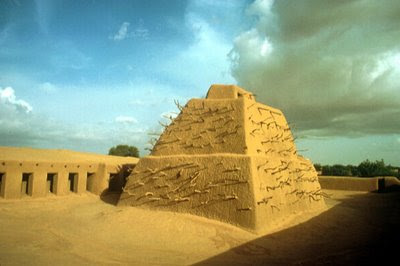
Left: Egyptian step pyramid [Djoser's], and right: The Askia tomb [Mali], mimicking the structure of a step pyramid.

Burial mounds gave way to Mastabas, and Mastaba traditions matured into the grand Egyptian pyramids. Tombs like the Askia structure too ultimately derive from indigenous Sahelian tumuli traditions associated with burials. Courtesy archnet library, we are told for example...

The Tomb of Askia is the central commanding feature of the Great Mosque of Gao. This layout pays homage to the Saharan tradition of prominent ancestral tumuli or tomb mounds erected over graves that date to before 1,000 BC. This large feature was incorporated into a new mosque building tradition in which the mosque itself becomes a combination of tomb, minaret and sacred enclosure. - archnet library

Courtesy of UNESCO World Heritage Collection,…  

Criterion (ii): The Tomb of Askia reflects the way local building traditions in response to Islamic needs absorbed influences from North Africa to create a unique architectural style across the West African sahel. Criterion (iii): The Tomb of Askia is an important vestige of the Empire of Songhai, which once dominated the sahel lands of West Africa and controlled the lucrative trans- Saharan trade. Criterion (iv): The Tomb of Askia reflects the distinctive architectural tradition of the West African sahel and in particular exemplifies the way buildings evolve over centuries through regular, traditional, maintenance practices.  


Head-supports: the first image shows that from Mali, and the second image shows that from the Nile Valley, dating to Dynastic Egypt. Head-supports like these are yet another common theme across Africa.


Gourd ornamentation is a widely practiced tradition on the African continent. In the images above, although the specimens themselves in question are from vastly different time frames, with the Sahelian example being the far more recent example, the remarkable parallelism in the themes of the art is hard to miss. On the left, we have the image of an Egyptian example dating back to the Nagadan period some time in around the 4th millennium BC, while on the right, we have a sub-Saharan example from west Africa.


Some interesting pectorals, from the Nile Valley and sub-Saharan west Africa. In this case, we have pectorals sporting ram heads, demonstrating remarkable parallelism; the examples here, include one from ancient Egypt and Nigeria (?). The ancient Egyptian example is obvious on the top right hand side, sporting a ram head with a sun disc.

Perhaps one of the most prolific recurring feature of art sporting Egyptian royalty or elite, is the staffs, of which the Was-scepter is famous. Again here, parallels can be seen between the physical manifestations of the ancient Egyptian examples and those from elsewhere in Africa; Egyptologist ABOUBACRY MOUSSA LAM for example, had gone to great lengths to show parallels between the Egyptian staff designs and those from both west Africa and east Africa, citing examples like the Fulani and Dogon amongst other groups.

Below, we have an early and a rather simple rendition dating back to ca. 3500 BC, found in the Hierakonpolis tomb 100, sporting several individuals holding what appear to be Was scepters.


And here, we have a mock up of a Was scepter:


The following "Hangool" staff of Somali make, is reminiscent of the Was scepter, with its forked base...


Similarly, here we have the "Woko" staff from Ethiopia...


The following is a "North Saharan" — from "Kargur Talh" in particular — rendition dating to ca. 6ky to 7ky BP; it notably sports a male figure holding what appears to be a staff, reminiscent of the Was scepter...


This is all for now; as more examples come in, this post will continue to be refined.

Sunday, October 26, 2008

Ancient Nile Valley influences in Extra-Nile Valley Art

Herein we will look at various Nile Valley influences in contemporaneous cultures around the Mediterranean sea and its spread thereof. For instance, given the Egyptian incursions into the Levant, Canaan in particular, their cultural impact in that area should really come as no surprise. In this regard, Egyptian involvement in the said region had taken a noticeably resolute turn under Rameses II; and under the 25th Dynasty, we see further Egyptian military adventures in the area, mainly against Assyrians. Additionally, of course, mainland ancient Greece, and its precursor cultural complex in the Cretan islands — the Minoan social complex, were notably recipients of ancient Nile Valley cultural diffusions. Let's take a look at examples...

Kushites in "Mesopotamian" art:

 -  -
A male likely of Kushitic-origin, carrying a leopard skin, and accompanied by a monkey, and an oryx: Neo-Assyrian; 8th–7th century B.C.
Excavated at Fort Shalmaneser, Nimrud (ancient Kalhu), Mesopotamia
"Phoenician style" Ivory; H. 5 5/16 in. (13.5 cm)
Rogers Fund, 1960

From the Metropolitan Museum of Art, we are told: Phoenician ivory carvers were strongly influenced by the themes and style of Egyptian art owing to longstanding ties between the two cultures. Some Phoenician ivories illustrate purely Egyptian themes, but many use Egyptian motifs in entirely original compositions.


Specifications [Hint: click on the photo to get a higher resolution]
Height: 10.350 cm
Width: 10.200 cm
Thickness: 2.450 cm (max.)
Weight: 151.000 g
ME 127412
Room 57-9: Ancient Levant

Courtesy of the British Museum, we are given the following comments about the above the ivory piece displaying what appears to be a Kushitic boy being attacked by a lioness:

Inlaid ivory panel of a lioness devouring a boy

Phoenician, 9th-8th century BC From the palace of Ashurnasirpal II, Nimrud, northern Iraq

'I'm not sure how I feel about this piece, however it sort of brings to mind a piece of memorabilia of a black figure. It's quite sensual looking, the young African man appears to be held in a kind of embrace by the lioness. It's also reminiscent of Dracula imagery in Europe too. His hair and facial features tell me that he is indeed a young African man but the museum title doesn't mention this, and I wonder why. It's very common for this kind of omission to occur. There's something about this boy, there's gold leaf on him, and armlets, it suggests to me that he may have been important in some way, was he a noble family's son perhaps?' Anita Mckenzie, of African, Caribbean and Indian heritage

The panel was found at the Assyrian capital city of Nimrud in northern Mesopotamia. It was recovered by the excavator Max Mallowan from the bottom of an ancient well in the palace of the Assyrian king Ashurnasirpal II (reigned 883-859 BC). It had probably been thrown there during the destruction of the palace in the late seventh century BC. The carving is Phoenician in style, which suggests that the piece of furniture may have been made in one of the Phoenician centres along the Levantine coast, and come to the Assyrian capital as tribute or booty. The carving shows an African boy with jewelled armlets and bracelets being attacked by a lioness. Above them is a dense network of lilies and papyrus. Much of the surface of the ivory was once overlaid with gold leaf and inlaid with carnelian and lapis lazuli. Some of this survives and there are traces of the blue mortar into which the lapis lazuli inlays were pressed. The African wears a short kilt covered in gold leaf. The curls of his hair are marked with gold. A spot of lapis lazuli is also inlaid on the forehead of the lioness. D. Collon, Ancient Near Eastern art (London, The British Museum Press, 1995) R.D. Barnett, A catalogue of the Nimrud ivor (London, The British Museum Press, 1975) J.E. Curtis and J.E. Reade (eds), Art and empire: treasures from (London, The British Museum Press, 1995)

What is being referred to as "curls of his hair" above, could very likely be a wig, relatively short and frizzy — the kind that had become a sort of Kushitic signature wear, that is — amongst the rich pool of fascinating and diverse garments often displayed on the people of Kush and thereof, Meroe; this may explain why it is also tinged with gold. Perhaps the wig style in question is made rather more obvious on the aforementioned "Nubian" figure at the very top, accompanied by the monkey and oryx figurines. The interesting thing about this "Nubian" figurine, is that we are told that it is presumably that of a tribute bearer (as is supposedly also the case in the one below, carrying an antelope-like creature on his shoulders); one can only discern from this, that such personalities were presumably captives of war stationed in the Levant or the vicinity thereof itself, that is — as opposed to personalities sent by a semi-autonomous regime in either the Kushitic or Egyptian complex under foreign rule, but it is worth remembering that, neither Kush, nor Dynastic Egypt under the 25th Dynasty rulers of Kushtic origin, were ever brought under the Assyrian territorial hold. One will recall that the Kushites were a force to be reckoned with, even from the Roman standpoint, when Egypt was brought under the Roman sphere of influence. Their reputation as fighters seems to have led to their call for "rescuing" the ancient Hebrews from Assyrian onslaught, sometime during the 25th Dynasty [see: The Rescue of Jerusalem: The Alliance Between Hebrews and Africans in 701 B.C., by Henry T. Aubin (April 1, 2003)].


A "Nubian" male likely of Kushitic-origin [S881 Nimrud Ivory], carrying what appears to be an antelope-like creature on his shoulders, and leading a what looks like a calf at the same time. The kilt style, that distinctive-looking short frizzy wig, and armlets appear to be reoccurring themes on these "Nubian" personalities, whom to reiterate, were very likely of Kushitic-origin. This neo-Assyrian era [ca. 800 BC] carved ivory too was uncovered in the Nimrud region. Dimensions & Measurements [presumably of figurines]: Height: 5.5434 cm, Height: 3.5434 cm, Height: 7.5434 cm and ID: 8341

One can only assume that these were carved by artistically-skilled Nile Valley war captives themselves, or just as likely [in fact, the more likely scenario of the two, given the synchronizing of Phoenician style renditions with Nile Valley themes], their former allies in the so-called Near Eastern region, now under some form of foreign control, if indeed these items are depicting "tribute bearers" paying tribute to some non-Nile Valley authority; not to be ruled out, these carvings could well also be the work of artists of Assyrian origin themselves, depicting presumably "tribute bearers" from amongst personalities of Assyrian captives of war, and/or "symbolic" renditions of their rivals or enemies, presumably of both "Nubian" and some "Near Eastern" origin, as tribute to some new found authority of Assyrians. If so, this might likely have coincided with the timeline when Kushitic rulers of 25th Dynasty Egypt withdrew their hold on Egypt, and presumably retreated back to Kush. Again, notwithstanding, it should be noted that no record of note has been brought to the fore, suggesting that either Egyptian or Kushitic territory were brought under direct control of Assyrians. On the other hand, Assyrians supposedly did find some opportunistic-ally in a native Egyptian ruler after the 25th Dynasty. Not to be dismissed either, and one that is noticeably overlooked in some quarters, is the possibility of these ivory items being attained through exchange of trade relations, as nothing particularly about the themes of the "Nubian" animal tenders in question standout as indicative of one under captivity or prisoner of war. This may be an even more likely scenario than any of the aforementioned speculations, when one considers the fact that many of these so-called "Nubian" human figurines appear to be well-dressed for the time and place in question, decorated or ornamented and healed; nothing about them speaks aloud of "involuntary servitude". As far as the earlier reckoning by Anita Mckenzie is concerned, with regards to the armlets, it might well be over-signifying the role of the armlets, as it appears to have been one of those reoccurring themes on "Nubian" personalities of these ivory carvings. All three renditions of "Nubian" personalities above appear to be sporting said armlets, not to mention necklace [particularly obvious on the topmost figurine image posted here]; the image-resolution of the figurine right above, not to mention the wear and tear of the article itself, does not allow one to ascertain whether the male therein too is wearing a bracelet, but clear enough to show that he is certainly wearing an armlet. The boy being attacked certainly is wearing bracelets. As far the issue of the importance attached to the inlaying of the attire with gold is concerned, well, that may be another matter.

Below, we have a golden plague displaying Amenemhat IV offering Atum ointment. The plague is said to be likely from Byblos, which lay in what is now part of modern Lebanon. It supposedly dates back to the 12 Dynasty era, ca. 1795 BC, courtesy the British Museum...


Specifications: Width - 3cm , and length - 3cm; EA 59194

Courtesy of the British Museum, we are told this about the piece:

The plaque was made using the technique called 'ajouré'. The design is cut out of sheet metal by using a chisel to punch around the outline; the Egyptian craftsman did not possess shears or fine saws. To get over the difficulty of producing smooth edges, strips of metal were soldered onto the base plate to provide cells into which inlay could be added. This technique was often used to produce pectorals and other pieces of jewelery. Openwork pieces without further adornment are quite rare. Here the details on the figures and hieroglyphs have been chased onto the metal using a fine chisel and mallet. The work is of extremely high quality, particularly the delicate modeling of the muscles of the legs of the figures. The discovery of the plaque at Byblos shows that Egypt had contacts, probably through trade, with this important port during the Middle Kingdom (2040-1750 BC).

E.R. Russmann,Eternal Egypt: masterworks of (University of California Press, 2001)

I. Shaw and P. Nicholson (eds.), British Museum dictionary of A(London, The British Museum Press, 1995)

S. Quirke and A.J. Spencer, The British Museum book of anc(London, The British Museum Press, 1992)


Next, is a Phoenician style bronze bowl, dating back to ca. 800 BC, uncovered at Nimrud, which is now part of what is northern Iraq; it clearly depicts human figures, in particular—faces spread in a "petal-like" fashion towards the center of the bowl, sporting Egyptianized facial themes, like for example, the extended eye-lines, and wearing unmistakably conventional Egyptian royal headdresses; also, visible in some areas, and nearer to the edges of the bowl, are several standing figures, wearing what appears to be Egyptian-style headdresses or crowns...


Specifications: Width - 8.5 in, length - 8.5 in, and thickness is 1 in; ME N65

Courtesy of the British Museum, the following descriptions for the bronze bowl above is provided to us:

The slaying of the demon Humbaba This very fragmentary bronze platter was discovered in the last century in the palace of the Assyrian king Ashurnasirpal II at Nimrud. It was probably acquired as tribute or booty by the Assyrian monarchs as they led their armies towards the Mediterranean.

The decoration is typically Phoenician,
a mixture of Near Eastern and Egyptian motifs. One figure with raised hands and gripping a demon's hair has been identified as related to the slaying of Humbaba. This is part of the story of the Mesopotamian hero king Gilgamesh who, with his companion Enkidu, defeated the demon Humbaba. This tale is first known from Sumerian stories of the early second millennium BC, but by around 1200 BC the Epic of Gilgamesh, which incorporated the Humbaba story, had became known throughout the Near East: fragments of cuneiform tablets recording the tales are known from Megiddo in Palestine, Emar on the Euphrates, south of Carchemish, and Hattusas, capital of the Hittites in Anatolia.

Here the slaying of Humbaba is incorporated into a scene where figures are depicted as Egyptian pharaohs
.

W.G. Lambert, 'Gilgamesh in literature and art:
the second and first millennia' in Monsters and demons in the anc (Mainz, 1987)

A.H. Layard,
Discoveries in the ruins of Ni (London, J. Murray, 1853)

From the following 'black and white' Chicago Oriental Institute photo collection, we come across a number of Neo-Assyrian era ivory carvings, which are noticeable for their display of discrete examples of major Nile Valley head-gear styles:

A plethora of Egyptian themes incorporated into Phoenician-style/influenced art had been uncovered in the Nimrud area, not to mention reoccurring displays of figures wearing the double crown [sporting a rearing uraeus/cobra-like figure], like in the rendition below...


Specifications: Ivory; width at the top - 3.5cm, width at the bottom - 5.1cm, height - 6.5cm and thickness - .6cm; excavation number - ND9423. It dates back to ca. 800 BC.

Not in a too different style, other Nile-Valley themed figures displaying wigs, along with crowns, are shown kneeling, with arms raised — reminiscent of the figure above...


Image - front and back end; specifications: Ivory; width - 3.2cm, height - 3.8cm, and thickness - .7cm, dating back to ca. 800 BC or so; excavation number - ND10479.

Notice the attempt to give the wig a frizzy look, and then of course, on top of the wig, a rather small-sized double-crown head-gear is seen. Others yet, like the example below, are only shown with the wig, with no crown at all...


Specifications: Ivory; height - 4.4cm, width - 3cm, and thickness - .6cm; excavation number - ND10658, dating back to ca. 800 BC.

The figure above, perhaps more worn off when compared to the example immediately above it, is unmistakably wearing a wig, but this time around, no display of a crown.

In lieu of the traditional Red and/or White crown, in certain cases, a winged sun-disc head gear is portrayed, like the examples below...


Specifications: Top fragment is ivory, with a height of 2.5cm, width of 2.7cm, and a thickness of .4cm; bottom fragment has a height of 2.4cm, a width of 3.2cm, and a thickness of .5cm. The item, with an excavation number of ND13395, as appears to be the case for all the other Neo-Assyrian era items [uncovered in the Nimrud region] mentioned, dates back to ca. 800 BC or so.

In the rendition above, rather than a wig on this occasion, the kneeling figure is wearing the conventional ancient Egyptian royal-style "cloth" headdress.

Here is another example, but a rather more complete one this time around, with even the neck gear showing...


Specifications: Neo-Assyrian era carved ivory uncovered from the Nimrud area; height - 5.2cm, and width - 3.1cm; excavation number - ND13155.

Rather incomplete, but from what is displayed on what remains of the head-figure, one notices a crown with a uraeus (cobra-like figure) attached to the front...


Specifications: Neo-Assyrian era Ivory; height - 3.5cm, width - 4.4cm, thickness - 1.2cm, and a tenon of 4.9cm; excavation number - ND13456.

Hey, forget about conventional human figures just wearing a headdress and/or even a crown! Why not have something vastly different altogether [from the examples above], but still keeping with Egyptian themes? Yeap, a Heru-like rendition fits the bill...


Specifications: Neo-Assyrian era Ivory; height - 6.3cm and width - 3.4cm; excavation number - ND10486.

The kneeling-figure rendition above essentially displays a comprehensive assortment of ancient Egyptian themes; from the double-crown, the falcon head gear, to the distinctive wig attached. The figure's short-sleeved top/robe is yet another visibly distinctive element, vis-a-vis the various examples of attire already shown in the other imagery so far posted.

Back to imagery in color! Below, we have in color, a display with many things going on in there...


Specifications, courtesy of the Metropolitan Museum: Egyptianizing figures on either side of a tree with a winged disk, 8th–7th century B.C Neo-Assyrian Mesopotamia, Nimrud (ancient Kalhu) Ivory; H. 4.88 in. (12.4 cm) Rogers Fund, 1962 (62.269.3

Much of what is displayed in the ivory carving above, is pretty much obvious, although some might have a little trouble in either identifying certain objects or how one interprets certain objects: Across the top portion of the ivory-carving, there are what appears to be 10 "cobra" heads, each displaying what appears to be sun-disc crowns. Right beneath those cobra heads, one notices a "winged" sun disc. Then comes the two male figures, each wearing the double crown; in between them, one sees a large plant-like "scepter" or shaft that is rooted in the ground and sporting large horn-like extensions [which might well have been intended to be caricatures of leaves, emulating the horns of a ram], and topped off by what might be a petal-like gear. Close to either side of the plant structure, both males appear to be holding onto a small ram-headed shaft/scepter in their right hand, each sporting a sun disc crown on their head. Near the base of the said middle shaft or trunk of the plant figure, a branch from its either side springs out, terminating into what appear to be leave renditions [which appear to emulate the horns of a ram], with each topped off by petal-like structures. The male figure on the right hand side, appears to be holding yet another scepter or shaft in his left hand; this shaft seems to be the conventional Egyptian "Was" scepter. Whereas the male figure on the left hand side, is holding an "ewer" in his left hand. Now, the attire of these two male figures in itself is interesting — there appears to be some cloak-like extension, from their waist-line, emanating from their kilt, perhaps attached to the kilt by a belt or "belt-like" form. On the kilts, one notices designs sporting "hanging" cobras or uraei, in lieu of where a "penis" sheath would otherwise be shown; in fact, such a sheath appears to be more apparent on the kilt of the male figure standing on the left hand side, but on the inside of the kilt. Other visible items are, a "rearing" uraeus attached to the front of the crown of the male on the left hand side [it appears to have been chipped off on that of the male on the right hand side], the neck gears of both the male figures, and their "fake" or symbolic beards usually reserved for figures of royalty and/or divinity.

Going "Persian"!...


Cyrus the Great

It doesn't take much of an imagination to see that the figure of 'Cyrus the Great' above is wearing an Egyptian crown — in particular, the triple Atef flanked by uraeus on either side.

Switching gears for a moment to Greek art, and traces of Nile Valley themes therein...

The following Archaic Greek life-size statues are notable for the postures, with hands clutched and the left foot a step forward from that of the right counterpart. Now where have we seen this theme? Ah yes, the theme was popularized by ancient Egyptians, as we will shortly see examples of...


Courtesy of GreekLandscapes.com, we are told: Kore (Phrasikleia) by Ariston of Paros and Kouros, lifesize, circa 550 B.C. Found in a pit at Merenda in Attica in 1972.
Note the posture of especially the male figure on the right.

"Behind the Phrasikleia Kore in the picture from the National Museum of Athens we see a Sphinx found at Spata in Attica. Marble, circa 570 B.C. Sphinxes were used to top funeral stele in Attica until 530 B.C." - GreekLandscapes.com

Here is a closeup example of another Greek statue...


Courtesy of GreekLandscapes.com: Kouros Marble, lifesize, circa 540 B.C. Found at the cemetery of Anavysos

Now, compare the body posture of the above figure, with that of the Egyptian pharaoh (Menkaure) below...

 -

The Greek examples have their arms to their sides and hands clutched in pretty much the same manner as pharaoh's (Menkaure's), but in the pharaoh's case, he is actually holding onto something; note the step forward by the pharaoh's left foot, vis-a-vis the right one. The Greek examples seem to have done away with the tiny detail of holding an object firmly in the hand, but the overall theme of the body posture, reminiscent of that of the pharaoh example above, leaves not doubt about from where the Greeks came up with the idea; and in fact, courtesy of GreekLandscapes.com, we have:

"The frontal pose, the left foot extended forward, the arms attached or close to the hips, the rigid pose, and the mysterious smile are all characteristics of the Kouros and Kore statues of the Archaic period. The sculpture of the Archaic Greek style is evidently influenced by ancient Egypt as the commerce between the two countries was flourishing."

Perhaps the above mentioned posture is made no more apparent than the following example from ca. 550 BC...


Courtesy of GreekLandscapes.com: Kouros
Lifesize, circa 550 B.C.
From the island of Melos.

The comparisons may well not be entirely complete, unless an ancient Egyptian example — completely naked, like the case usually was with the Greek examples provided here — is thrown in, so as to match the Greek examples in both total nakedness and general posture:


Although the available resolution of this image is quite low, what appears to be a distinctively Afro-hair style look, is hard to miss.

In the Minoan collection, we bump into this falcon rendition, dating to ca. 1700-1550 BC...


Specifications: Length: 4 cm, height: 2.1 cm, and weight: 45.5 g; excavation ID - GR 1876.11-20.2 (Jewellery 817).

It is heavily tinged with Egyptian theme, so much so that if it weren't for the supposed "head" rendition, even the British Museum commentators would have reckoned it to be a fully-imported Egyptian item. To put it precisely in their own terms, they say:

Although this falcon was found in Crete, it is very Egyptian-looking in style and technique. Falcons were important in Egyptian symbolism: the sun-god Re was represented above all as a falcon, the perfect symbol of power in the sunlit skies of Egypt...

It has also been suggested that the style of the head is not Egyptian, so it could be a Minoan work heavily influenced by Egyptian jewellery. In either case it is evidence of contacts and artistic exchanges between the two areas at the time.


Furthermore...

The wings originally had an inlay: faint traces have been identified as diopside, a semi-precious stone. It is possible that the bird was originally part of a larger and more elaborate piece of jewelery, perhaps occupying the corner of an Egyptian pectoral (chest) ornament of roughly rectangular shape. A small, rough hole at the top of the bird's back, and two neat holes through the tip of the talon and the right wing were perhaps for attachment. However, the holes may have been made to adapt the piece, perhaps as a pendant, and this work may have been done in Crete.

R. Higgins, The Aegina Treasure: an archae (London, 1979)

Taking a look at an example, unquestionably Egyptian in origin...


Specifications: Gold pectoral of a hovering falcon From Egypt; dating to about the Late Period, after 600 BC; Width: 14.800 cm.

A fairly decent description of this falcon had been provided by a British Museum commentator; this is how it went:

Inlaid with multi-coloured glass

Pectorals first appear in royal burials of the Middle Kingdom (about 2040-1750 BC), but are known from wall decoration of the Old Kingdom (about 2613-2160 BC). They are usually made of precious metal, inlaid with semi-precious stone or coloured glass. Pectorals were often placed on the chest of the mummy. Twenty-six pectorals were found in the tomb of Tutankhamun. Some were placed on his body, while others were found in one of the Anubis shrines and chests. Many pieces were worn during life as they show signs of wear.

The decoration of pectorals was often associated with kingship, and with the protection of the gods. Symbols for eternity, life and protection are also often included. Falcons with outstretched wings were a popular motif. Their form allowed for elaborate and colourful inlays. The falcon was associated with the sun god, and with the ba. The ba was the element of an individual which is close to what we would call the 'personality'. The ba, represented by a bird, usually with a human head, was believed to stay close to the body.

S. Quirke and A.J. Spencer, The British Museum book of anc (London, The British Museum Press, 1992)

Turning to the Sphinx, perhaps the most famous Nile Valley artistic theme aside the pyramid!...


Photos of the Giza Sphinx, supposedly taken in 1849 and in 1870 by Maxime du Camp and Sebah respectively.


Sphinx photos purportedly taken in 1877, in 1880 by Zangak, and 1885 respectively.

Not sure about the dates attributed to these photos, but what can be said without a doubt, is that they were likely taken sometime in the 19th century. What is worth noting about these photos, is the changing status of the Sphinx, not to mention attention to its immediate surroundings. Take note for example, that in some photos, the Sphinx is only visible from head to shoulders, with the remainder of its body covered by sand, while in later photos, more of its body is exposed.

There has been reckoning elsewhere that the basic idea of the Sphinx may have actually spread from the Nile Valley to the so-called Near East, and then from there — that is, if not directly from the Nile Valley, to Greece, and thereof, to the "far East". Of course, the supposed counter-argument given to this, is the idea that animal-human mythic renditions are naturally reoccurring themes in human societies; some even make a simple case about the mere availability of certain animal types in the region in question, being some sort of a condition that would deter or even insulate a region from importing a theme involving the animal(s) in question. Perhaps an example of this may be seen in the image below, displaying a Nok [lay in what is now part of Nigeria] wood carving, wherein one notices the human head united with the body of some "dog-like" (?) creature; the peculiar body makes it difficult to immediately identify it with the Sphinx, since it doesn't appear to invoke that of a sitting lion in any immediate sense, and yet, its tail appears to be rather peculiarly too long and slender to be immediately identified with a conventional figure of a dog...


Thanks to a poster in a discussion board, the following scans of various renditions of the so-called "Near Eastern" Sphinx, along with some examples that are reminiscent of Egyptian renditions, were made available:


In getting back to that issue about the Nile Valley origin of the Sphinx concept, some reckoning about an independent "Near Eastern" conception of the Sphinx is predicated on the idea that they are contemporaneous, and this supposedly comes from comparing a "life-size" old Kingdom Sphinx — as opposed to the Giza example — with the earliest example supposedly from "Mesopotamia". These advocates date the said Old Kingdom Sphinx earlier than the Giza example; the premise for this is rather flimsy — based on the rigidly-held, if not more a romanticized one, idea in some circles that Khufu must have built the Giza Sphinx. Recent findings by geological experts have put these perceptions of the Giza Sphinx into question. The findings that have been arrived, make it difficult to reconcile the building of the Giza structure with its supposed undertaking some time in the Fourth Dynasty era; dates attained from the geological examination of the structure, at the least go back to the pre-dynastic era. Several of such dating have taken the age of Giza Sphinx back to as far as the turn of the early Holocene, and some consider these to be still "conservative" estimates, while others play it even "safer", by placing to dates that are nearer to the foundation of Dynastic Egypt, but still predating it, mainly out of fear of being typecast as "ridiculous". While these fairly early dates have been attained from examining the overall structure of the Giza Sphinx, many of the experts who attained those dates, all agree that some renovation work on the Giza Sphinx structure had clearly taken place as well; this is where the reworking of the structure at certain points in the Dynastic period, with one of the earliest examples having likely been undertaken some time in the Fourth Dynasty, is not ruled out. Based on these findings, the logical conclusion to be reached, is that the Giza Sphinx represents the earliest example of Sphinx found anywhere, and hence, serves as the definitive Sphinx. Indeed, at least one French author/researcher had been cited acknowledging the concept of Sphinx originating in, or at the very least, first appearing in the Nile Valley before it makes its appearance anywhere else, including the so-called "Mesopotamia".


This carving of the Sphinx of Hetepheres II, daughter of Khufu, dating back to the Fourth Dynasty, is what some refer to as possibly the oldest example of Egyptian Sphinx, even though these same folks would also generally acknowledge that the supposed work on the Giza Sphinx also dates to this period. Now of course, the caveat that comes along with the aforementioned geological examinations that date the Giza Sphinx structure to the pre-dynastic era, is that given the associated researchers generally agree that the Sphinx face as we know it — would have been a major area of reworking upon the orders of the pharaoh [Khufu], so as to have the Sphinx face carved in his image, it is fairly likely that the original face of the Sphinx with which it would have initially been carved is lost to us. After all, the wisdom here, is that Khufu's face would have been different from the original facial rendition of the Giza Sphinx. Even so, one is rarely directed to the specific "Mesopotamian" Sphinx(s) that is supposed to be contemporaneous with the Fourth Dynasty examples.

The mere prospect of lions having been available in the so-called "Mesopotamia" in no way insulates that region from having imported the concept of Sphinx from the Nile Valley, any more than it has insulated the "far East" from having initially imported the concept from Classical Greece, and possibly the so-called "Mesopotamia". On the backdrop of what has been noted above, no "Mesopotamian" Sphinx rendition dates either as early as or earlier than the Giza Sphinx. Initially importing the concept does not preclude its "localized" evolution thereof, as seems to have been the case in say, the "far East". For instance, on a discussion board, one person noted the routine "sitting" posture of ancient Egyptian Sphinxes, while many "Mesopotamian" examples, though by no means an exclusive thing, are shown "standing" all on fours; another person noted the obvious "winged" element of many "Mesopotamian" examples — that the "winged" Sphinx actually proceeds the non-winged example in "Mesopotamia", as a further evolution of the concept therein and hence, are generally figured in later art than the non-winged examples, would have been duly taken into consideration before any presentation of such an element as a supposed counter-argument against concept of Sphinx as initially a cultural import in the so-called "Near East". Pictorial examples of these winged-Sphinxes will follow shortly. Hence, if the mere presence of lions in the so-called "Mesopotamia" had inspired "Mesopotamian" locals of the concept of Sphinx, it certainly doesn't seem to have occurred until well after the idea had originated in the Nile Valley desert.

Wikipedia is a source, as noted here before, that warrants referencing with a critical-eye, and as such, when an unnamed Wiki-author says the following about the Sphinx, the claim is immediately followed up with either cross-referencing it with or at the least, tracing it back to its purported "primary" named sources/authors, which are noted below...

In contrast to the sphinx in Egypt, Mesopotamia, and Greece, where the traditions largely have been lost due to the discontinuity of the civilization,[6] the traditions of the "Asian sphinx" are very much alive today.

— Where "[6]" is supposedly referenced from: Demisch, Heinz (1977). Die Sphinx. Geschichte ihrer Darstellung von den Anfangen bis zur Gegenwart.

The above is followed up with this:

The earliest artistic depictions of "sphinxes" from the South Asian subcontinent are to some extent influenced by Hellenistic art and writings. These hail from the period when Buddhist art underwent a phase of Hellenistic influence. But the "sphinxes" from Mathura, Kausambi, and Sanchi, dated to the third century BC until the first century AD, also show a considerable non-Hellenist, indigenous character. It is not possible, therefore, to conclude the concept of the "sphinx" originated through foreign influence.[7].

— Where "[7]" was supposed to have been referenced from the website titled 'sphinxofindia.rajadeekshithar.com', authored by Raja Deekshithar; that website for its part, put it this way:

The earliest textual reference to the sphinx of India is found in the Yajur Veda. The earliest known depictions in stone of sphinxes are found in central and north-west India and date to the 1st century BCE till the 2nd century CE. They are found among the decorations of Hindu, Buddhist and Jain shrines. And they show distinct Hellenistic influences especially in that they often have wings of the type typical of Greek sphinxes.

The earliest dated example of a sphinx in southern India is found among the sculpture in Mamallapuram. In the 6th and 7th century kings of the Pallava dynasty experimented in the vicinity of this ancient port with various architectural and sculptural forms. The domination of the Pallavas was eclipsed in the 9th century by the Chola kings, whose centre of power lay in the delta of the Kaveri river. The Cholas dominated southern India for over four centuries and made generous contributions towards the temples and towards the arts, generating some of the greatest treasures of human civilization. It was in the temples constructed and supported by them that we find many of the early sphinx sculptures. In this period the main characteristics of the purushamriga are lion bodies, with mane, and only a human face, with elongated ears. A few are depicted crouching, and in pairs. Most are striding or jumping. During this period we also see occasionally purushamriga that have the lower body of a lion, with the upper body of a human being, and are shown half up-right. Often they are engaged in the worship of the Shiva Linga with a lamp and a bell. Many of the depictions are narrative panels relating the story of the chase of Bhima by the purushamriga from the Mahabharata. In other parts of India we also find sphinxes depicted in the various local artistic idioms. In the temples of Orissa, for instance in Konarak, Banpur and Garudipancana, besides the half upright lion-human sphinxes, we find the sphinx also as an upright being with a human body, lion’s claws for legs, feet and hands, and human head with fangs. Here they are called Nara-virala... The crouching sphinx with mane and elongated ears. This possibly belongs to the earliest depictions in the specifically Indian artistic idiom. Striding and jumping sphinxes with only human faces also belong largely to early phases. The half upright lion-human figures generally seem to belong to somewhat later to much later phases of development. The fully upright life-size purushamriga represent the final phase of the artistic development of the sphinx in Indian art.

The author concludes with this...

After the early stages of art in north and central India, there is no further evidence for Hellenistic influence. It is therefore possible to conclude this influence was temporary and only relevant with respect to the style of depiction, and did not pertain to or reflect on the concept of the sphinx as such.

And elsewhere the same author says this:

The earliest textual reference to the purushamriga is found in the Yajur Veda in connection with the ashvamedha, the horse-sacrifice. The earliest datable sculptural representations of sphinxes in India are found among the archaeological remains of the Hindu, Buddhist and Jain shrines dating to the first century BCE to the first and second century CE. These belong for the most part to the period of the Kushana dynasty and follow the style of Gandhara art. Examples have been found in Mathura, Bodhgaya, Bharhut, Gandhara, Sanchi, Orissa and other places. Various composite Mythologyological creatures, among them sphinxes, adorn the capitals of pillars, reliefs and freezes. Although the earliest sculptural depictions of sphinxes in the South Asian subcontinent are clearly influenced by Hellenistic inspired early Buddhist art, this does not in my view establish or confirm that the concept of the sphinx was introduced to South Asia through Greek influence. The best argument is that the Buddha himself was first depicted under Hellenistic influence by artists of the Kushana kingdom in the period of Gandhara art . This does not by any means make Gautama the Buddha a Greek prince and saint. According to the doctrinal and oral traditions of south India, the purushamriga is first mentioned in the Yajur Veda, which is dated to a period long before the time of the Greek influence on Indian art. And its ritual role continues till today, in the lamp ceremonies and processions of south Indian temples.

And this...

"The next datable illustration of a sphinx in Indian art is found among the monuments of Mamalapuram, an ancient sea-port some 50 kilometers south of the capital of Tamil Nadu, Chennai (formerly Madras)... The excavation of this cave shrine is dated to the early to middle 7th century. Mamalapuram was one of the centers for the trade between India and the Roman Empire. And Greco-Roman artistic influence cannot be excluded."

Now of course, the key words here are "the earliest" examples show foreign influence, while the progressive or later examples seem to show less and lesser foreign influence. This goes back to the aforementioned point about initial cultural diffusion not precluding eventual localization of an imported concept, and hence, the turning of an initially imported concept into an original local design(s). As noted by the author, not unlike the case of Buddha, the mythic personality of the Purushamriga, for instance, may well itself predate Hellenistic themes in Indian art, but who is to say that the preexisting physical manifestation of this mythic figure did not 'transform' into that of the Sphinx concept, as a result of foreign cultural infusion; to be certain, primary texts ought to clue us in on the prospect of exactly when the Purushamriga took on the form of a Sphinx. Even so, it is highly doubtful that this would be contemporaneous or older than the appearance of the concept in the Nile Valley.

The author tells us that "Purushamriga" means just this:

"The sphinx of India is known as purushamriga, which means human-beast in Sanskrit. Depictions in various styles from different historical periods are found all over the South Asian subcontinent."

And the standard definition of the Sphinx is this...

"According to the dictionary, a sphinx is a composite mythological being with the body of a lion and a human head."

"human-beast" says nothing of the standard definition of the Sphinx, as exemplified by the Giza Sphinx. That aside, the author of course correctly assigns terms for the Sphinx concept according to Egypt, ancient Greece, and India respectively; namely, Sheshep-Ankh [Egyptian terminology], Sphinx [Greek terminology] and Purushamriga [Indian terminology].

The following excerpts from the author in question are particularly interesting:

The author questions..."Could it be concluded from the visual and textual evidence I have gathered through my research and presented in this website, that this mythological composite being called purushamriga is identical with or possibly related to the sphinx known from other parts of the ancient world?"

And sure enough, the author answers..."The description is fitting, and so is the definition. Also the functions are almost similar."

And thereof, the answers to the following questions put forth by the author himself, are answered along the way by himself in many cases...

Questionnaire put forth: "And in case we could prove or establish a relationship, would it have its source in synchronicity, be rooted in an archetypal origin, or would it be one of derivation? And if the sphinx was a cultural derivation, we would have to answer the question whether it was derived from one part of the ancient world to the other, or from a common source."

Connection #1, as acknowledged by the author:

Basic form of a lion body with a human head.

Connection #2,

Other remarkable parallels with the depiction of sphinxes in the ancient art of West Asia and the Mediterranean area are the pairing of male-female purushamriga

Connection #3,

The placement near temple entrances, their depiction on thrones, as vehicles of deities, and trampling on a warrior.

Connection #4,

Recognized artistic and stylistic influence from Hellenistic sources. This was probably short-lived, in the north-western and central Gangetic plain from the 1st century till the 2nd century BCE. Sometimes the sphinx is here depicted with wings. Although this influence doesn’t seem to have existed beyond this time and area it does show possibly a certain exchange did take place.

Connection #5,

There are many similarities in the functions of the purushamriga in India and the sphinx of the ancient world. The latter is described as a being of secret and sacred knowledge. In India the purushamriga is said to be a great yogi and depicted as a rishi or seer.

Connection #6,

Both the sphinx and the purushamriga guard the entrances of temples and ward off evil.

Connection #7,

Both are portrayed as worshipping and as announcing the epiphany of the deity. Both are also sometimes functioning as the vehicle of deities.

Connection #8, even though the author presents this as a case, wherein the Indian perception is purportedly deviant from the others mentioned, it nonetheless serves to show parallelism between the other cultures mentioned,...

But although the civilizations of Egypt, West Asia and the Mediterranean see the sphinx as primarily a solar symbol, in the Yajur Veda it is stated to be dedicated to the Moon.

Given these connections laid out above between cultures with the Sphinx concept, let us now confront the concluding questions put forth by the author:

Question: Are the purushamriga in Indian sculpture and ritual associated to the sphinxes of other parts of the ancient world?

Answer: Given the number of commonalities or parallels above, it is rather hard to miss the associations between the said Sphinxes around the world; the number of connections are indeed considerable enough to simply dismiss the phenomenon as mere convergence of independent ideas on different parts of the planet.

Question: Are they derived through artistic or mythological influence?And if so, was the derivation from West to East, or from East to West?

Answer: The aforementioned connections argue for both; mythological influence and artistic influence. Given that the earliest attested Sphinx is found in the Nile Valley, and from what we've just read from the author himself, it is evident that the flow of the basic concept of Sphinx was one of West to East direction, with the Nile Valley Sahara being the likely ultimate origin of the concept.

Question: Or is the sphinx a mythological concept that originates from human civilization beyond our historical horizon? From an as yet un-identified common cultural source? Or do they derive from the archetypal and mythological sub-conscious of ancient peoples?

Answer: As just noted, the connections mentioned are numerous enough to simply dismiss them as mere coincidence. If the basic concept of the Sphinx had independently occurred in different regions of the world, it certainly had not occurred by way tangible evidence, in other parts of the world either prior to or as early as the Nile Valley concept. Given the abundance of well-preserved material in the so-called "Mesopotamia" for instance, when compared to situation in the Nile Valley, it is hard to reconcile that its inhabitants had known about the Sphinx concept all along, at the same time it emerged in the Nile Valley, and yet did not have the instinct to artistically express them. The above mentioned "connections" do seem to hint on a common cultural source; the pointers thus far examined, ultimately place this common cultural source in northeastern Sahara. An ultimate common cultural source to reiterate, does not preclude synchronization of the imported basic-concept with local traditions. Hence, the idea that the said Sphinxes around the world share a common cultural source is not necessarily mutually exclusive to the prospect of synchronization of an initially-imported basic concept with either preexisting and/or newly developed local mythology.

From the referenced website, the following photo collection of the Indian Sphinx are provided:


The first image dates back the era when the earliest artistic examples of Sphinx makes its appearance in the India subcontinent from ca. 100 BC - 200 CE, and the second image, is an example that dates back to the Pallavas Dynasty [ca. 400 CE to 900 CE]


Another example of a "winged" Sphinx, likely amongst of the early examples, and a relief sporting some Sphinx figures at the top of the building.


Relatively later renditions, compared to the examples presented above. Also, more localized artistic themes are apparent here.


Sitting examples of Sphinx, reminiscent of the seemingly most favored posture by ancient Egyptian artists.

Getting to the pictorial examples of so-called "Mesopotamian" Sphinx renditions noted above, with these ones mainly dating to the Neo-Assyrian period...


Specifications: Phoenician style ivory carving dating to ca. Neo-Assyrian period, uncovered at Nimrud (ancient Kalhu).

Apparent Egyptian themes in the rendition above include: Egyptian-style eye lining, conventional royal headdress, triple atef crown, and neck gear. To the right forelimb, next to the Egyptian-style apron, is a hanging uraeus or cobra, displaying a frontal profile and with a sun-disc on its head.


More Neo-Assyrian era examples of 'winged' Sphinxes, reminiscent of the example provided above; specifications for the first Sphinx rendition: Ivory; Phoenician style, dating to ca. 9th-8th century BC, and found at Nimrud (ancient Kalhu), northern Iraq.

Specifications for the second Sphinx rendition: Height: 6.9 cm, width: 7.75 cm and thickness: 1 cm; Ivory; Phoenician style, dating to ca. 9th-8th century BC, and found at Fort Shalmaneser, Nimrud (ancient Kalhu), northern Iraq; excavation ID - ME 134322.

In the first rendition, we come across the recurring theme of the royal headdress with a uraeus attached to its front, and topped off by a double crown this time around; the Egyptian-style neck gear is also visible, along with the hanging Egyptian-style apron-like attire, not to mention the Egyptian-style eye lining on the Sphinx's face. In the second rendition, again one notices the Egyptian style eye lining on the face, the hanging apron-like attire, the headdress, and what appears to be a small-sized double crown on top of it. Could easily be missed, if not carefully observed, is a uraeus or cobra [visible near the right forelimb] possibly hanging from neck-gear. Note the reappearance of ram-horn looking leaf extensions [in some cases, topped off by 'petal-like' figures] emanating from trunks or plant shafts rooted in the ground [seen in all three Sphinx renditions above].


Specifications for the seated Sphinx: Horse blinker with sphinx, 8th–7th century B.C. Neo-Assyrian; Ivory; height - 4.13 in. (10.49 cm), uncovered in Mesopotamia, Nimrud (ancient Kalhu); Rogers Fund, 1954 (54.117.1)

On the fish-shaped platform above, the obvious Egyptian themes are, the conventional royal headdress, topped off by a sun-disc head gear, which itself sports a uraeus featuring a miniature sun-disc on its head. Hanging from the chest area of the Sphinx, is another uraeus, also featuring a miniature sun-disc on its head, but this time, with wings attached to the neck-area of the cobra featured. On the tail-end of the fish-shaped platform, is an Egyptian themed shaft [of a lotus plant?], furnished with a cartouche decorated with hieroglyphs.

More Decorated Bronze Bowls...


Specifications: Diameter: 18 cm and height: 2 cm; Bronze bowl with Egyptian motifs, Phoenician style, dating to about 8th century BC, and Found at Nimrud, northern Iraq; excavation ID - ME N59.

The bronze bowl, like the one posted at the top of this post, but apparently better preserved, is notable for recurring Egyptian themes; namely, what appears to be a Sun-like structure in the center and encircled by winged Sphinxes wearing royal Egyptian headdresses and head gear flanked by kneeling human figures, also wearing Egyptianized-headdresses and attire, holding shafts in either hands. According to the British Museum's site, 'similar bowls have been found at various places in the Mediterranean, including the Greek mainland, Crete and in Etruscan tombs'.


Specifications: Diameter: 21.700 cm and height: 2.850 cm; Phoenician style, 8th century BC Found at Nimrud, in the palace of Ashurnasirpal II - northern Iraq; excavation ID - ME N9.

The bronze bowl above sports a decorated center encircled by images of "winged" Sphinx pairs on all fours facing one another, each wearing the famous Egyptian double crown on top of what appears to be a falcon-head gear or simply, falcon head, and each putting their right forelimb on some not-so-identifiable figures [due to inadequate resolution of the image], with some sort of a plant figure in between them. The Sphinx pairs are alternately flanked by a slender plant-like structure, which in turn is flanked by yet another but broader trunk plant-like figure, topped of by the well known Egyptian-style scarab/beetle caricature.


Specifications: Ivory; diameter: 18 cm and height: 2 cm; Phoenician style, dates to about 8th century BC, and found at Nimrud (ancient Kalhu), northern Iraq; excavation ID - ME N25.

On this bronze bowl, the central figure of the Egyptian-style scarab/beetle immediately jumps at one; it is encircled by alternating representations of fully-seated [in a manner reminiscent of most renditions of Egyptian Sphinxes] "winged" Sphinxes facing one another, each sporting human heads wearing the conventional Egyptian royal headdress, with plant-like structures in between them, one of which seems to be topped off by a hovering "winged" uraeus or cobra; the Sphinxes are flanked by a cluster of plants, followed by what appears to be antelopes or deer-like creatures facing one another, while flanking what appears to be a "winged" cobra hovering over a plant on the one hand, a cluster of plants in between, and a beetle (?) over a plant on the other. More of elements of these figures re-appear nearer to the circumference of the bowl, in alternating fashions once again. Again, according to the notes of the British Museum, similar bowls have been uncovered in mainland ancient Greek, Cretan, Etruscan tombs, and regions around the Mediterranean sea.

The Sphinx tradition was no less featured the Sinai peninsula of Egypt, which is worth noting, as this is a well-known corridor for bidirectional migration and exchange of culture...


Specifications: From Serabit el-Khadim in the Sinai, Egypt; dating to the Middle Kingdom, around 1800 BC; excavation ID - EA 41748.

A notable feature of this particular Sinaitic Sphinx, clearly adhering unwaveringly to conventional Egyptian themes, is inscriptions on it, both in standard hieroglyphics and "proto-Sinaitic". It must be remembered that the term "proto-Sinaitic" itself may be a tad misleading, in light of such inscriptions having been recently found deep in the Nile Valley—a far as Abydos in particular. At any rate, courtesy of the British Museum, we are told...

Inscribed in both hieroglyphic and proto-Sinaitic scripts

This sphinx was found by Flinders Petrie in the temple in the mining settlement at Serabit el-Khadim. The semi-precious stone turquoise was extracted here from the Middle Kingdom (2040-1750) onwards. Hathor, the goddess associated with turquoise, is named in the hieroglyphic inscription on the right shoulder of the sphinx. The proto-Sinaitic inscription includes a name composed of a similar shape; the name is of a goddess similar to Hathor. This suggests that the inscriptions are bilingual, giving the same information in both languages, as on the Rosetta Stone.

That said, judging from the following claim and from the fact that is even acknowledged right therein that the so-called "proto-Sinaitic" signs derived from hieroglyphics, apparently, some one forgot to tell the British Museum commentator who wrote the piece, about recent "proto-Sinaitic" findings in Abydos, that predates any such inscription found anywhere...

Proto-Sinaitic script has been found on a small number of objects and in inscriptions in the Sinai, Palestine and the deserts around Egypt. It consists of at least twenty-three signs, half of which seem to be **derived from hieroglyphs**. The appearance of the script in the later Middle Kingdom coincides with Egyptian trading interests in Palestine and it is likely that the script originated in Palestine or Syria to write a West Semitic language. It is not certain whether it has yet been fully or correctly deciphered, although pioneering work was carried out by the scholars Alan H. Gardiner and W.F. Albright and has been continued by Benjamin Sass.

The British Museum authors need to get with the program; that is the least one would expect from a Museum!

Greek examples of the Sphinx...


Left: A rendition of Oedipus and the Sphinx, and Right, courtesy of the Metropolitan Museum of Art: Sphinx-shaped finial of a marble grave stele (total height: 423.4 cm) of a youth and a little girl, Attica, ca. 530 BC. Metropolitan Museum of Art (New York), Inv. 11.185.

In a passing, while examining the bronze bowls uncovered at Nimrud, we came across the scarab; well, here is another artistic rendition of the scarab in the so-called "Mesopotamian" art, obviously inspired by Egyptian artistic conventions...


Specifications: Stamp scarab seal with winged figures, 6th–5th century B.C; found in the Levant or Syria; Ivory in green jasper; height - 3/8 in. (1.02 cm); found by W. Gedney Beatty, 1941 (41.160.162)

This seal apparently has two pieces; the scarab-engraved and shaped piece fits into the pit engraved into the piece on the right hand side. If there is any doubt about the source of inspiration of the scarab, well, the themes on the piece on the right hand side of the image, quickly removes such doubt; on that piece, one notices two "winged" female figures facing one another, wearing head gears sporting the sun-disc. The two females flank what appears to be a rendition of Ausar [see in between the wings of the female figures], wearing a distinctive solar-disc integrated crown [likely a double atef crown], and on the very top, is a hovering "winged" sun-disc.

Notes on the piece, courtesy of Metropolitan Museum of Arts:

Around the beginning of the first millennium B.C., Phoenician seal engravers adopted the use of the scarab, an Egyptian symbol of regeneration. In typical Phoenician fashion, the seals were decorated with Egyptian motifs that are juxtaposed out of context, sometimes with non-Egyptian animal subjects. Popular subjects included the birth of Horus and scenes of his mother Isis nursing him as an infant. Winged protective deities and genies were also favorite themes. Iconographically, the seals of the eighth to seventh centuries B.C. have a close dependence on Phoenician carved bowls and ivories. Phoenician scarab seals reached a peak of popularity in the fifth to fourth centuries B.C., when they spread throughout the Mediterranean. The city of Tharros on Sardinia was a major center of production and distribution. By this time, the seals were carved with not only Egyptian themes but also Etruscan and western Greek imagery.

What next? Ah, the pyramid!...

Well, pyramids are generally-speaking, more widespread than any of the concepts mentioned herein so far, and the cultural-traditions and techniques behind building them, generally differ markedly in their themes. That being said, it is not exactly a secret that the ancient Roman examples [notably, the Pyramid of Cestius ~ ca. 12 BC] were generally inspired by the Nile Valley examples, and much more recently, i.e. in contemporary times, the Germans were inspired by the Giza example, to build a large modern tomb in the shape of a pyramid. Referenced works that probably aid in furthering our understanding of these inspirations, include: Lawrence J. F Keppie, Understanding Roman Inscriptions, pp. 104-105. Routledge, 1991; Jean-Marcel Humbert, Clifford A. Price, Imhotep Today: Egyptianizing Architecture, p. 27. Routledge Cavendish, 2003; and James Stevens Curl, The Egyptian Revival: Ancient Egypt as the Inspiration for Design Motifs in the West, pp. 39-40. Routledge, 2005. The Roman examples actually more emulated the Meroitic-style pyramids than they did the larger Giza examples; after all, the Romans had presided over attack against Meroe a few centuries earlier, prior to the reign of Cestius [~ca. 23 BC].


Cestius' Pyramid

This will be it for now, but this post will be the subject of ongoing revision and/or updating, as is the case with virtually all other postings here, as more information on Nile Valley influences on non-Nile Valley art come to attention. So, stay in touch!
______________________________________________________________
*Appreciation to Museums of the British Museum, the Chicago Oriental Institute, the Metropolitan Museum of Art, and not to leave out the photo collection of Raja Deekshithar.